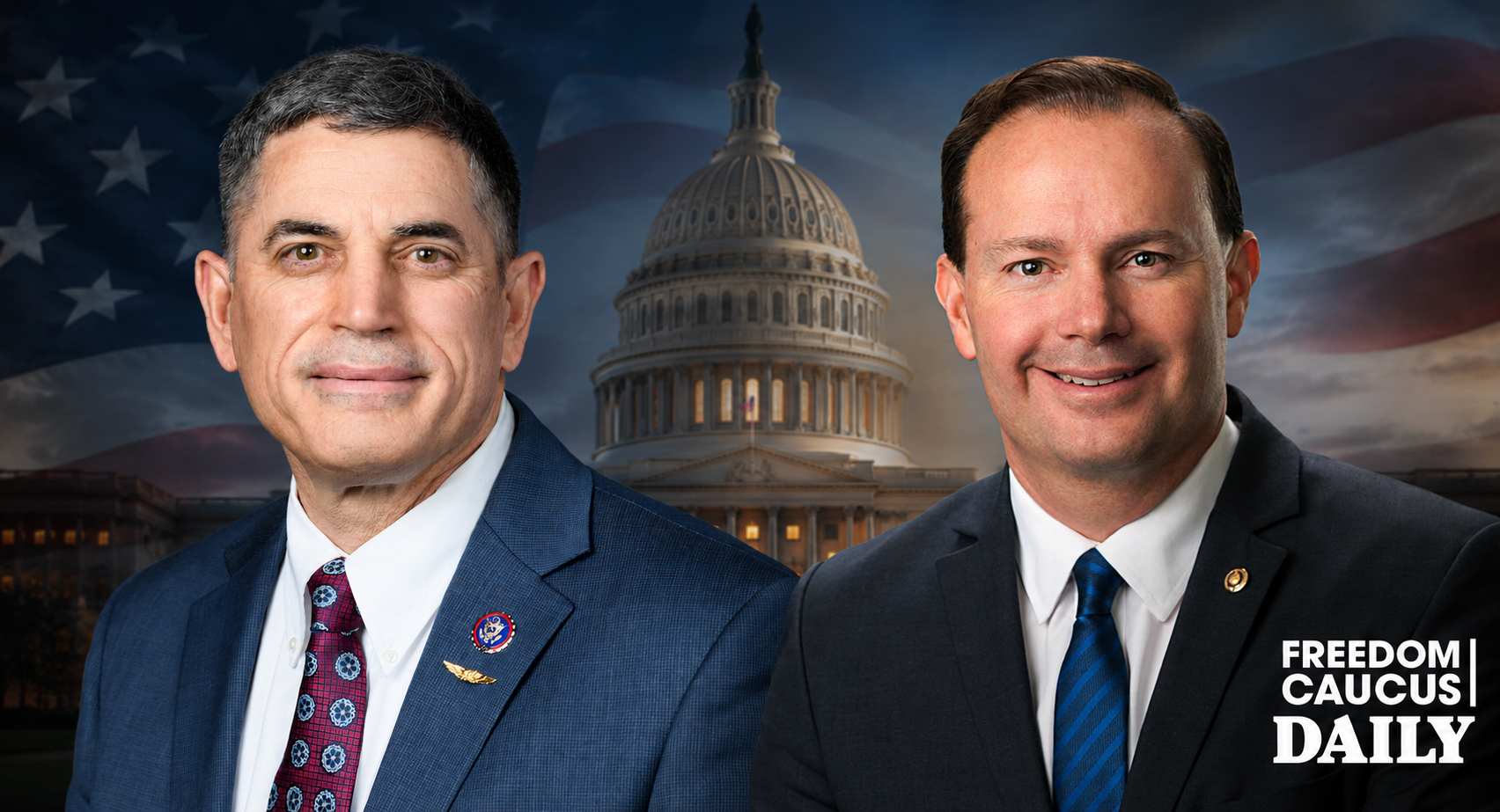
Georgia Representative Andrew Clyde and Utah Senator Mike Lee have introduced the End EPA Abuse Act, a bill that would prohibit the Environmental Protection Agency from issuing regulations that effectively eliminate gas‑powered vehicles or force a nationwide energy transition — authority the lawmakers argue Congress never granted and the agency has repeatedly claimed for itself.
The legislation targets a pattern Clyde and Lee say has defined federal environmental policy for years: regulators reinterpreting decades‑old statutes to accomplish policy goals that could not survive the legislative process. Their bill would bar Clean Air Act regulations that would significantly expand the EPA administrator’s authority beyond what Congress intended, drawing a firm line between enforcement and lawmaking.
“The End EPA Abuse Act is not a panacea to the administrative state, but it’s a start,” Clyde said. “Reining in the EPA is one step toward restoring a simple principle that Washington has too often forgotten: The people, not the bureaucrats, rule.”
The EPA was established to enforce federal law, not write it. Under the Obama and Biden administrations, critics say the agency used its regulatory authority to impose sweeping changes — vehicle emissions standards designed to phase out gas‑powered cars, energy rules crafted to accelerate the retirement of fossil fuels — without a formal act of Congress. Each time a court struck down one version of those rules, a modified version emerged under a subsequent administration.
That cycle is precisely what Clyde and Lee say their bill is designed to break. Without a structural limit on how agencies can expand their own authority by reinterpreting existing statutes, the same legal arguments return in new forms regardless of who holds the White House. The End EPA Abuse Act seeks to close that gap by prohibiting the agency from using the Clean Air Act as a vehicle for authority Congress never explicitly conferred.
The constitutional argument at the center of the bill is straightforward. Lawmakers face voters. Agency officials do not. When consequential decisions about energy, transportation, and the economy are made by unelected administrators rather than elected representatives, there is no mechanism for public accountability — no ballot, no recourse, no consequence.
The Supreme Court addressed a version of that argument in its 2022 ruling in West Virginia v. EPA, which found that the agency had exceeded its statutory authority in attempting to restructure the nation’s power sector. Clyde and Lee say the End EPA Abuse Act codifies and extends that logic, giving Congress a legislative tool to enforce its own boundaries rather than relying on courts to do so after the fact.
If the United States is going to phase out gas‑powered vehicles or fundamentally alter its energy system, the bill’s sponsors argue, those decisions belong in Congress — debated, amended, and voted on by representatives who must answer to the people who sent them.
The legislation is expected to advance through committee review in the coming months, with its prospects in the Senate likely to depend on how closely leaders tie it to broader debates over executive agency authority and regulatory reform.