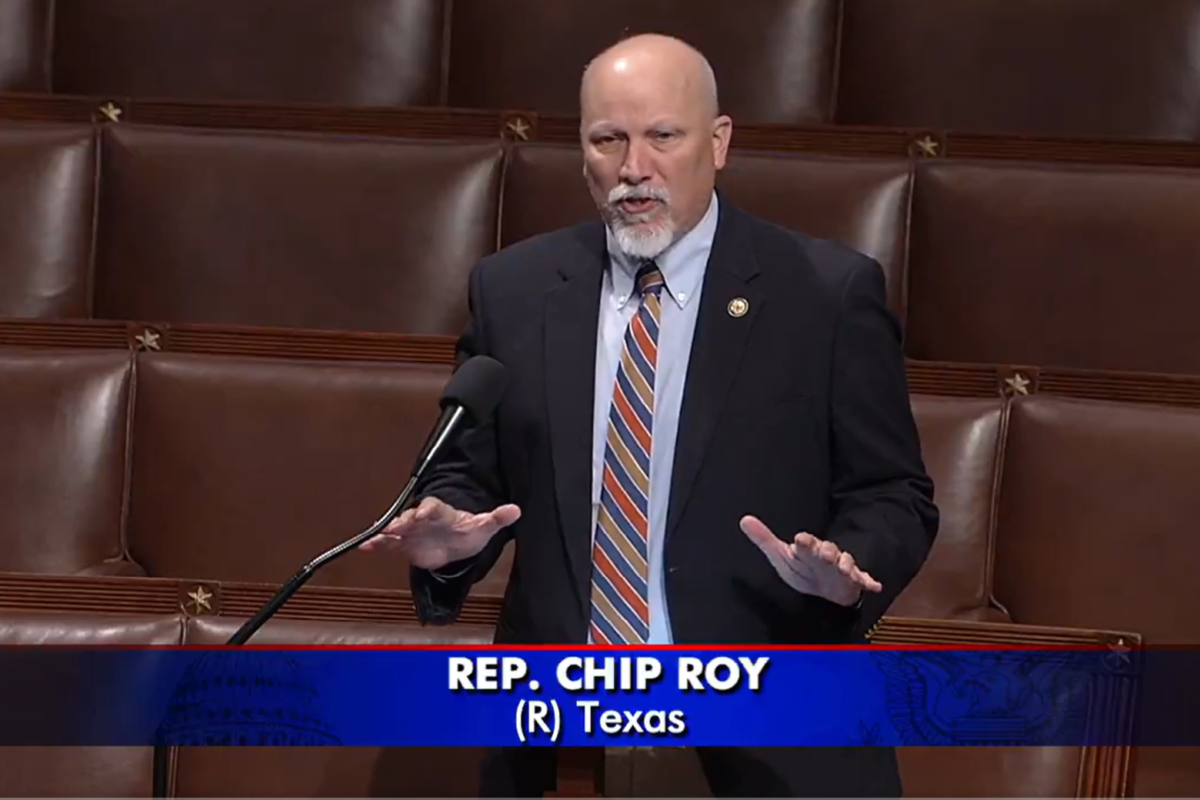
House Freedom Caucus members Chip Roy of Texas and Scott Perry of Pennsylvania voiced new opposition to expanding year‑round sales of E15, saying the proposal strengthens the Renewable Fuel Standard, creates new government mandates and increases financial pressure on drivers and refiners.
Their comments came in an op‑ed published in The Hill where they outlined a series of concerns about the mandate and its effect on fuel markets.
Roy and Perry said the Renewable Fuel Standard imposes direct costs on consumers. They wrote, “The Renewable Fuel Standard functions as a 30-cent hidden tax on every gallon of gasoline and diesel. Refiners are forced to buy tradeable compliance credits, the costs of which are passed straight to consumers at the pump.”
The two House Freedom Caucus members argued that the Energy Policy Research Foundation estimates the mandate adds 30 cents per gallon and that “over the last decade, the mandate has cost Americans about $164 billion in higher fuel prices.”
Perry and Roy wrote that the mandate becomes more expensive at higher blending levels.
“The absurdity is worse: The final mandated gallons of ethanol cost roughly $770 per gallon to force into the market. EPA’s own analysis projects an additional $6.7 billion in societal fuel costs,” the op-ed went on to read.
Roy and Perry contended the Renewable Fuel Standard does not resemble a market‑driven approach asserting that “This isn’t an energy policy — it’s a corporate bailout.”
In the piece, Roy and Perry maintained that the push for year‑round E15 does not expand consumer choice.
They wrote, “Year-round E15 isn’t about consumer choice; it is a government-mandated expansion by another name.”
Ethanol interests have acknowledged their goal of building infrastructure for higher blending volumes, Roy and Perry claimed, writing that without the Renewable Fuel Standard, “the market would largely stick with E10,” and that “only a minimal 0.34 percent of blending is truly driven by the mandate beyond voluntary levels.”
They said the mandate does not improve energy security. They wrote, “The Renewable Fuel Standard fails every justification offered for it. It doesn’t enhance energy security. One-third of the U.S. corn harvest yields only about 10 percent of our gasoline. Replacing gasoline with ethanol would require four to five times current corn production, which is impossible.”
Supporters of the Renewable Fuel standard argue it’s good for the environment
Perry and Roy disagreed, making their case that proponents of the fuel standard overstate the environmental impact, which does not match the policy’s stated goals.
“Full life-cycle emissions analysis shows corn ethanol often matches or exceeds gasoline’s carbon footprint, at an abatement cost of $1,464 per metric ton. It also increases smog, which is the very reason E15 was originally banned in the summer., Roy and Perry wrote.
Members of Congress on both sides of the upcoming vote on E15 agree that this carries broader implications.
Perry and Roy stressed that this “vote for E15 without reform to the Renewable Fuel Standard is a vote to expand a hidden tax on Americans,” adding that Congress should pursue “Real reform, on the other hand, is a vote for lower fuel prices, competitive markets and genuine energy dominance.”